Natural latex silk knowledge popularization: Model definition standards for latex silk
As the core auxiliary material for elastic fabrics, elastic bands, and various industrial products, the specifications and models of natural latex silk are crucial parameters in production and procurement. In the industry, the commonly used specifications and models of natural latex silk include 23 #, 28 #, 32 #, 37 #, 42 #, 52 #, 63 #, 75 #, 90 #, 100 #, etc. Many customers who are new to this product often have questions: What do these numbers represent?
1、 Definition standards for latex filament models
The naming of latex filament models originates from their traditional production process. Due to the extrusion stretching process used in the manufacturing of latex fibers, their theoretical cross-section is circular. The industry standard for defining models is:The number represents the number of latex threads that can be accommodated side by side within a width of 1 inch (approximately 2.54 centimeters).
Specifically:
• 23#Within a width of 1 inch, 23 latex threads can be arranged.
• 28#Within a width of 1 inch, 28 latex threads can be arranged.
• 32#Within a width of 1 inch, 32 latex threads can be arranged.
• and so on. .....
2、 The relationship between model number and wire diameter thickness
Based on the above definition criteria, we can draw an intuitive conclusion:The larger the model number, the finer the latex filament; The smaller the model number, the thicker the latex filament.
For example, the diameter of latex thread 42 # is significantly smaller than that of latex thread 23 #. In practical applications, latex fibers of different thicknesses correspond to different tensile strengths and rebound properties. Thicker latex fibers (such as 23 # and 28 #) are usually used in areas such as sofa elastic bands and elastic mattresses that require high tensile strength; Finer latex fibers (such as 63 #, 90 #, 100 #) are more commonly used in lightweight underwear, sock cuffs, swimsuits, and other textile products that require high comfort and delicate touch.
3、 Common specifications and appearance forms
At present, the mainstream latex filament specifications on the market cover a variety of models from coarse to fine, such as 24 #, 32 #, 37 #, 42 #, 48 #, 52 #, 63 #, 75 #, 90 #, 100 #, etc., which can meet the production needs of different ribbon enterprises.
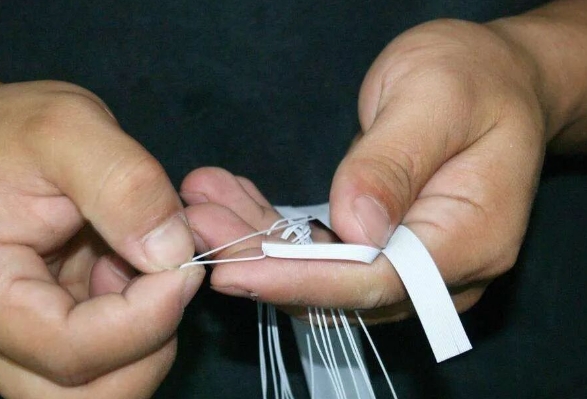
In the factory state, latex fibers are usually bare and packaged in groups of 40. The cross-section is circular, and the basic colors are divided into black and white. In addition, according to different surface treatment processes, it can also be divided into those covered with antioxidant powder on the surface; Powder” And covered with antioxidant oil; Oil tendon” Among them,“ Powder” More commonly used in the textile industry.
Understanding the model definition standards of latex yarn can help enterprises more accurately select accessory specifications that match their product needs in the procurement and production process, thereby improving the quality and comfort of the final product.