Why can't we use the same vulcanization system for silicone tubing, sealing rings, and food grade products?
Recently, we encountered a customer case where we used Double 25 for factory testing. The customer used platinum vulcanization instead of the same rubber, and the hardness measured was 3-5 degrees higher than our factory results. Today, let's have a brief discussion on the differences between different vulcanization processes? How should we choose?
When making silicone rubber products, people often ask:
“ This vulcanizing agent molded sealing ring is used well, why can't it be used to make rubber hoses? ”
Some people also believe that as long as platinum sulfide is used, the product will definitely be cleaner and safer.
Both of these understandings are incomplete.
Choosing a vulcanization system should not be based solely on the name of the product. It is necessary to consider the molding method, product thickness, heating conditions, odor requirements, usage environment, and regulatory requirements simultaneously.
Both silicone rubber, molded sealing rings, continuous extruded rubber hoses, food grade products, and liquid rubber injection parts face completely different vulcanization conditions, so the same solution cannot be applied casually.
1、 First of all, distinguish: vulcanization system and vulcanization process are not the same thing
The vulcanization system mainly refers to the reaction by which the rubber material forms a cross-linked network. The common types of silicone rubber are:
Peroxide sulfurization;
Platinum addition sulfurization;
Room temperature condensation sulfurization.
The vulcanization process refers to how this reaction is completed in production, for example:
Pressure vulcanization of flat plates or molds;
Hot air continuous vulcanization;
Liquid glue injection molding;
Steam vulcanization;
Room temperature curing;
Perform secondary vulcanization after one vulcanization.
The same vulcanization system can be used for different processes; The same type of product may also choose different systems according to requirements.
So, it cannot be simply said that '; Use peroxide for the sealing ring; “ Platinum is used for food products;. What really matters is how the product needs to be shaped and what requirements it must ultimately meet.
2、 Why is peroxide still used the most in ordinary molded products?
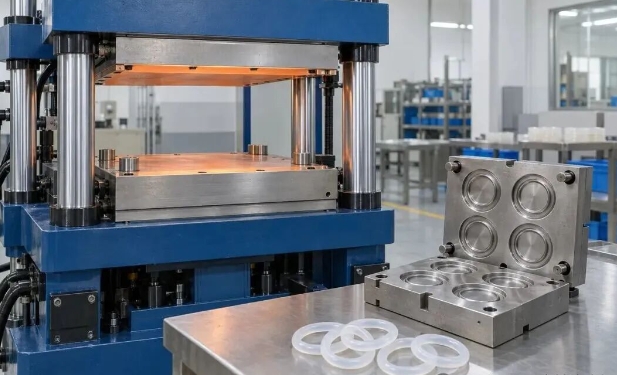
Ordinary sealing rings, rubber pads, buttons, and industrial miscellaneous parts are mostly heated, pressurized, and vulcanized in closed molds.
Flat vulcanizing machine, molding die and silicone rubber sealing ring
The flat vulcanizing machine uses heating and pressure to shape and complete vulcanization of the rubber material in a closed mold.
The characteristics of this type of process are:
Molds can shape products;
Pressure can limit the foaming and deformation of rubber materials;
Temperature and time are relatively easy to control.
In addition, most of these ordinary industrial parts are sensitive to production costs.
Therefore, peroxide vulcanization is still very common. It has mature technology, wide applicability, suitable cost-effectiveness, and is not as sensitive to cross contamination in the production site as the platinum system.
But; Peroxides” Not a fixed material. The decomposition temperature, vulcanization rate, and by-products of different varieties are not the same. Some are more suitable for thin products or lower temperatures, some are more suitable for ordinary molding and thick products, and some are suitable for hot air continuous vulcanization.
After selecting the wrong option, the common result on site is:
The surface is ripe, but the interior is not yet fully matured;
The product has a noticeable odor;
Yellow color and decreased transparency;
The surface appears white or frosted;
Demoulding may seem normal, but its performance is unstable after parking.
So, for ordinary molded parts, peroxide systems can be given priority consideration, but specific varieties should also be selected based on thickness, color, production temperature, and secondary vulcanization conditions.
3、 The difficulty lies not in extruding rubber hoses and strips; Can it be cooked; And in; How to become familiar after leaving the mouth mold;
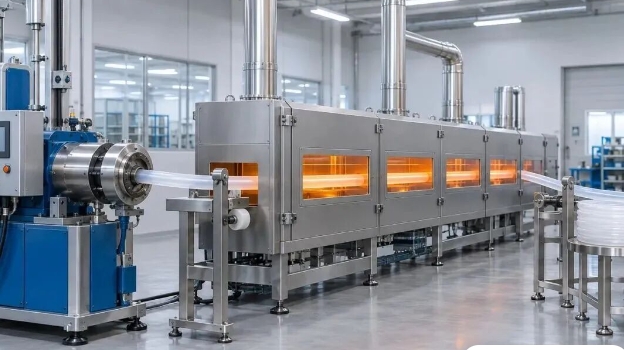
When molding, the rubber material is wrapped by the mold; When extruding, the rubber material needs to be continuously vulcanized in a hot air, infrared or steam environment after coming out of the mouth mold.
Silicone rubber extrusion and hot air continuous vulcanization production line
After the extruded product leaves the mouth mold, there is no mold support, and it needs to be shaped and vulcanized simultaneously during the continuous heating process.
At this point, without a mold to help it maintain its shape, there are more problems:
The surface must be shaped as soon as possible, otherwise it is prone to adhesion and deformation;
The internal and external heating rates are different, and thick walled rubber hoses are prone to external ripening and internal growth;
The volatile compounds and by-products generated during vulcanization are more likely to affect the surface;
When the extrusion speed changes, the actual heating time also changes accordingly.
Therefore, the peroxide used in extruded products should be able to adapt to continuous vulcanization under no mold pressure. It is not guaranteed that the same results can be obtained simply by transferring the vulcanizing agent used in molded products.
Platinum addition system can also be used for extrusion. It has a fast response and low odor, making it suitable for hoses and profiles that require high cleanliness and efficiency. But it has higher requirements for rubber formula, equipment cleaning, and temperature control.
Whether to choose peroxide or platinum for rubber hoses has nothing to do with who is more advanced. What really matters is whether the production line can be stably controlled, as well as what requirements the product has for odor, residue, efficiency, and cost.
4、 Why is platinum sulfide more commonly considered for food grade products?
Platinum addition vulcanization is an addition reaction between silicone rubber containing vinyl groups and hydrogen crosslinking agents to form a crosslinked network.
This type of reaction does not produce the by-products formed by peroxide decomposition, so it usually has several advantages: